Compounded Semaglutide vs. Wegovy: Cost, Safety & What the Evidence Shows
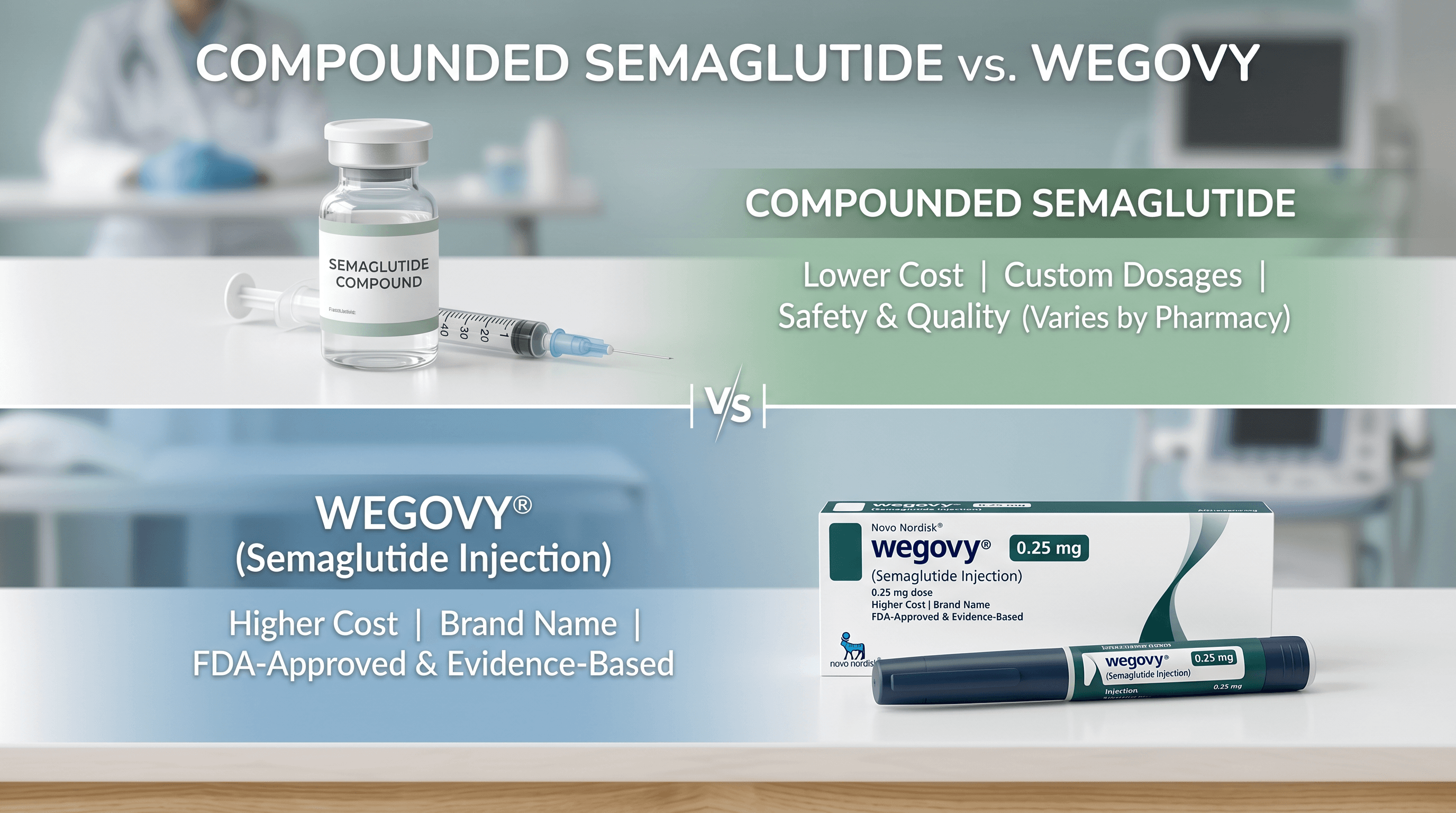
Compounded Semaglutide vs. Wegovy: Cost, Safety & What the Evidence Show
Brand-name Wegovy can cost over $1,000 per month. Compounded semaglutide programs are often a fraction of that price. What's actually different — and is the cheaper option safe?
KEY TAKEAWAY
The active molecule in compounded and brand-name semaglutide is chemically identical. The real differences are FDA-approval status, manufacturing oversight, and pharmacy quality. Cost can be $800+ less per month with compounded. This article explains the honest trade-offs — not a marketing pitch for either option.
If you've researched GLP-1 weight loss medications, you've noticed a striking price gap: Wegovy carries a list price of $1,300–$1,400 per month without insurance, while telehealth platforms offering compounded semaglutide programs charge $150–$350 per month for what appears to be the same medication.
The obvious question: what's the catch? This article walks through the pharmacology, manufacturing realities, regulatory landscape, and honest risks — so you can have an informed conversation with a licensed provider rather than relying on either pharmaceutical company PR or telehealth advertising.
What Is Semaglutide?
Semaglutide is a glucagon-like peptide-1 (GLP-1) receptor agonist — a molecule that mimics a naturally occurring gut hormone. It works through three primary mechanisms:
- Appetite suppression: Signals the hypothalamus to reduce hunger and food cravings — often dramatically.
- Gastric emptying delay: Slows how quickly food leaves the stomach, increasing satiety and naturally reducing portion sizes.
- Insulin regulation: Improves insulin sensitivity and reduces blood glucose spikes after meals.
Novo Nordisk markets semaglutide as Ozempic (FDA-approved for Type 2 diabetes) and Wegovy (FDA-approved for chronic weight management at a higher 2.4mg dose). The landmark STEP-1 clinical trial — 1,961 adults over 68 weeks — established an average weight reduction of 14.9% at therapeutic dose, with some patients losing over 20%.
What Is Compounded Semaglutide?
Compounded semaglutide is semaglutide prepared by a state-licensed compounding pharmacy using pharmaceutical-grade active pharmaceutical ingredient (API) sourced from FDA-registered manufacturers. It is not the same product as Wegovy — but the core molecule is identical.
US compounding pharmacies operate under two regulatory tiers:
- 503A pharmacies — Traditional compounding. Prepare medications based on individual patient prescriptions. Regulated primarily by state pharmacy boards.
- 503B outsourcing facilities — Higher-tier designation under the Drug Quality and Security Act (2013). Subject to FDA Current Good Manufacturing Practice (cGMP) standards and regular FDA inspections. The gold standard for compounded medications.
This distinction matters enormously. When evaluating any telehealth platform offering compounded GLP-1, always ask which tier of pharmacy they use.
The Molecule Is Identical — So What's Actually Different?
1. FDA Approval Status
Wegovy has undergone Novo Nordisk's full FDA approval process — Phase III trials involving over 4,500 patients, manufacturing inspections, and ongoing post-market surveillance. Compounded semaglutide is not FDA-approved. It has not been through a formal FDA review process.
2. Manufacturing Oversight
Wegovy is manufactured under strict cGMP at Novo Nordisk facilities with FDA batch oversight. For compounded semaglutide, quality depends entirely on the specific pharmacy. A 503B facility does rigorous batch testing; a substandard 503A operation may do minimal quality control. This is the biggest real-world risk.
3. Delivery System
Wegovy comes in Novo Nordisk's proprietary auto-injector pen with pre-measured doses. Compounded semaglutide typically comes as a multi-dose vial requiring a separate syringe and self-injection. A practical difference, not a safety concern.
4. Added Ingredients
Compounders may use different excipients or add ingredients like B12 or L-carnitine — additions that sound appealing but have limited clinical evidence for improving semaglutide outcomes.
Is Compounded Semaglutide Safe?
The honest answer: it depends on the pharmacy — and the risk is manageable with the right questions. A reputable compounded semaglutide program uses a pharmacy that:
- Holds 503B outsourcing facility registration OR PCAB accreditation
- Provides a Certificate of Analysis (CoA) from an ISO-accredited independent lab for every batch
- Discloses the source of their API (must be an FDA-registered manufacturer)
- Can answer specific questions about their Quality Management System
Always ask for the CoA before your first prescription ships. Any legitimate pharmacy will provide it within one business day.
⚠ RED FLAGS TO AVOID
Avoid any platform that:
- Cannot provide a Certificate of Analysis
- Cannot name their pharmacy
- Claims to offer 'oral semaglutide' compounds
- Prices well below $100/month without explanation
- Does not require a licensed provider prescription
The 2025 Regulatory Situation
The legal landscape changed significantly in 2024–2025. Compounding is legally permitted when drugs appear on the FDA's drug shortage list. Semaglutide appeared on this list during 2022–2024 due to supply constraints. In late 2024 and 2025, the FDA removed semaglutide from the shortage list — significantly narrowing the legal basis for 503B compounding at scale.
What this means for patients: the best platforms maintain both compounded AND brand-name Rx pathways. Always confirm your provider can transition you to brand-name Wegovy if the regulatory environment changes.
Frequently Asked Questions
Is compounded semaglutide the same as Wegovy?
The active molecule is chemically identical. What differs: FDA-approval status, manufacturing oversight, delivery system (vial vs. pen), and quality controls. Pharmacy quality is the key variable that determines safety in practice.
Is compounded semaglutide safe?
When sourced from a PCAB-accredited or 503B-registered pharmacy with documented independent batch testing (Certificate of Analysis), the risk profile is manageable. Quality varies significantly by pharmacy — this is why the CoA matters so much.
Why is compounded semaglutide so much cheaper than Wegovy?
Wegovy's price reflects Novo Nordisk's R&D investment, FDA approval costs, manufacturing scale, global marketing, and brand premium. Compounded semaglutide uses the same API but bypasses the brand-name supply chain and operates in a more competitive market.
Is compounded semaglutide still legal in 2025?
The legal basis changed after the FDA removed semaglutide from the shortage list. Large-scale 503B production lost its primary justification. Individual 503A prescriptions continue under other legal frameworks. Confirm the specific legal basis with your provider.
Does insurance cover compounded semaglutide?
No. Insurance does not cover compounded medications. Brand-name Wegovy may be covered by some commercial plans, often requiring prior authorization based on BMI and comorbidities. Compounded semaglutide is an entirely out-of-pocket expense — but FSA and HSA funds can be used.
Related Articles

Get your free wellness guide
Be among the first to receive science-backed wellness research, delivered weekly.
No spam, ever. Unsubscribe anytime. We never share your email.